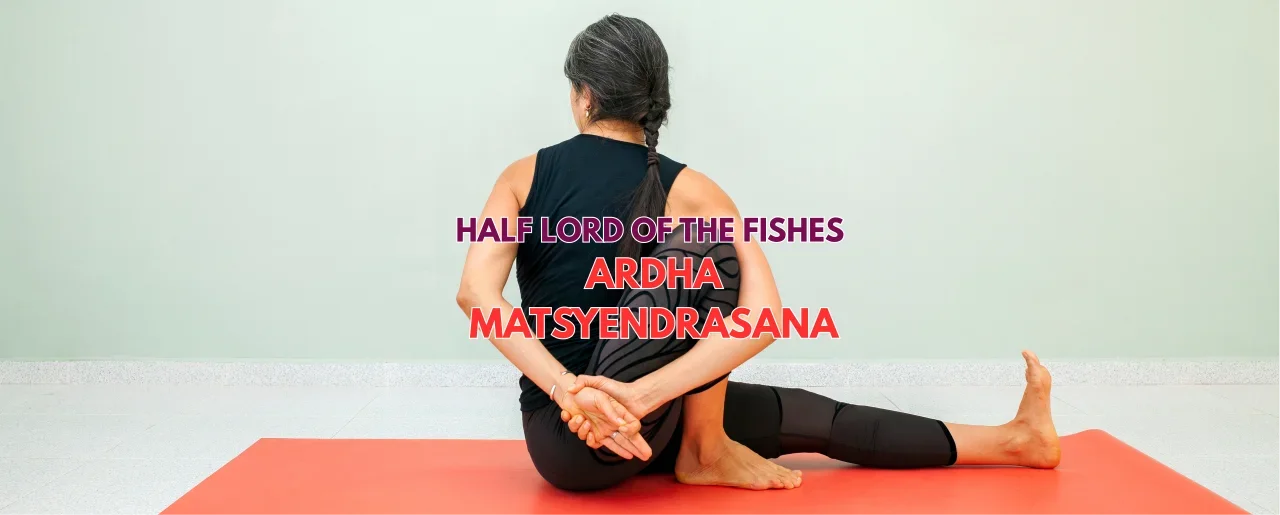
Ardha Matsyendrasana, commonly known as Half Lord of the Fishes Pose, is a seated spinal twist that develops awareness of spinal alignment, mobility, breathing, and posture. The Sanskrit name comes from “Ardha,” meaning half, and “Matsyendra,” referring to the Lord of the Fishes.
This traditional yoga posture is commonly practiced in Hatha Yoga and other yoga traditions. When practiced mindfully, it can help improve mobility around the spine, hips, shoulders, and upper back while encouraging controlled breathing and concentration.
What Is Ardha Matsyendrasana?
Ardha Matsyendrasana is a seated twisting posture performed on both sides of the body. One leg is folded while the opposite foot is placed outside the folded leg. The torso then rotates toward the bent knee while maintaining length through the spine.
The key principle of this posture is to lengthen the spine before creating the twist. Instead of forcing the body into a deeper rotation, practitioners should gradually explore their comfortable range of movement while maintaining steady breathing.
How to Practice Ardha Matsyendrasana
- Sit on your yoga mat with both legs extended forward in Dandasana.
- Bend your right knee and place your right foot outside your left thigh.
- Fold your left leg and bring the left heel toward the outside of your right hip.
- Keep both sitting bones grounded as much as comfortably possible.
- Inhale and lengthen your spine upward.
- Exhale and slowly rotate your torso toward the right.
- Place your right hand behind you for support.
- If comfortable, bring your left elbow toward the outside of your right knee.
- Keep your shoulders relaxed and avoid forcing your neck into the twist.
- Take several slow and comfortable breaths.
- Gently release the posture and repeat on the opposite side.
Benefits of Half Lord of the Fishes Pose
Regular and mindful practice of Ardha Matsyendrasana may provide several physical and mental benefits when it is suitable for the practitioner.
- Supports spinal mobility: The controlled rotation encourages movement through the spine.
- Improves hip mobility: The posture involves the hips and outer thighs.
- Encourages better posture: Maintaining an upright spine develops awareness of alignment.
- Engages the upper back: The twisting movement works different areas around the torso and upper back.
- Develops body awareness: Practitioners become more aware of alignment, breathing, tension, and movement.
- Encourages mindful breathing: Coordinating breathing with spinal length and rotation can make the practice more conscious.
Breathing Technique During Ardha Matsyendrasana
Breathing plays an important role in this seated twist. Begin with a comfortable inhalation while creating length through the spine. During the exhalation, gently rotate the torso without collapsing the chest.
Avoid holding your breath while practicing the posture. If the twist makes breathing difficult, reduce the intensity and return to a more comfortable position.
Common Mistakes to Avoid
- Forcing the torso into a deep rotation.
- Rounding or collapsing the spine while twisting.
- Using the arms aggressively to pull the body deeper.
- Rotating primarily from the neck instead of the torso.
- Lifting the sitting bones excessively from the floor.
- Holding the breath during the posture.
- Ignoring pain or sharp discomfort in the knees, hips, back, or neck.
Precautions for Ardha Matsyendrasana
Practitioners with existing back, spinal, hip, knee, or shoulder problems should approach this posture carefully. Anyone experiencing pain during the twist should stop the practice and seek guidance from a qualified yoga teacher or healthcare professional when appropriate.
Beginners may use a folded blanket under the sitting bones to make it easier to maintain an upright spine. The posture should be adapted to the individual's mobility rather than forcing the body into a particular shape.
Ardha Matsyendrasana in Yoga Teacher Training
Learning how to perform a yoga posture is only one part of becoming a knowledgeable yoga teacher. Students also need to understand alignment, breathing, anatomy, modifications, precautions, sequencing, and how to provide clear instructions.
If you want to study yoga more deeply in an immersive environment, explore our Nepal Yoga Teacher Training programs in Pokhara. The programs provide opportunities to study yoga asana, pranayama, meditation, philosophy, anatomy, and teaching methodology.
200 Hour Yoga Teacher Training in Nepal
Students beginning their professional yoga journey can explore the 200 Hour Yoga Teacher Training in Nepal. This foundational program introduces students to important aspects of yoga practice and teaching, including asana, pranayama, meditation, anatomy, and yoga philosophy.
Advanced Yoga Teacher Training in Nepal
Practitioners who have completed foundational yoga teacher training may consider an advanced program such as the 300 Hour Yoga Teacher Training in Nepal. Advanced training allows experienced practitioners to deepen their understanding of yoga practices, philosophy, Sanskrit, sequencing, and teaching methodology.
Why Study Yoga in Nepal?
Nepal offers a unique environment for students who want to explore yoga alongside traditional teachings, meditation, Himalayan culture, and a peaceful learning atmosphere. A structured Nepal Yoga Teacher Training program can help students move beyond individual asana practice and develop a broader understanding of yoga philosophy, pranayama, meditation, anatomy, and teaching.
Final Thoughts
Ardha Matsyendrasana is more than a seated twisting posture. It teaches practitioners to combine stability, spinal length, controlled rotation, and mindful breathing. Practicing slowly and respecting the body's current range of movement is more important than trying to achieve the deepest possible twist.
For students interested in developing a deeper understanding of yoga asana, anatomy, philosophy, pranayama, and teaching methodology, Nepal Yoga Teacher Training can provide an opportunity to study yoga in a dedicated learning environment in Pokhara.