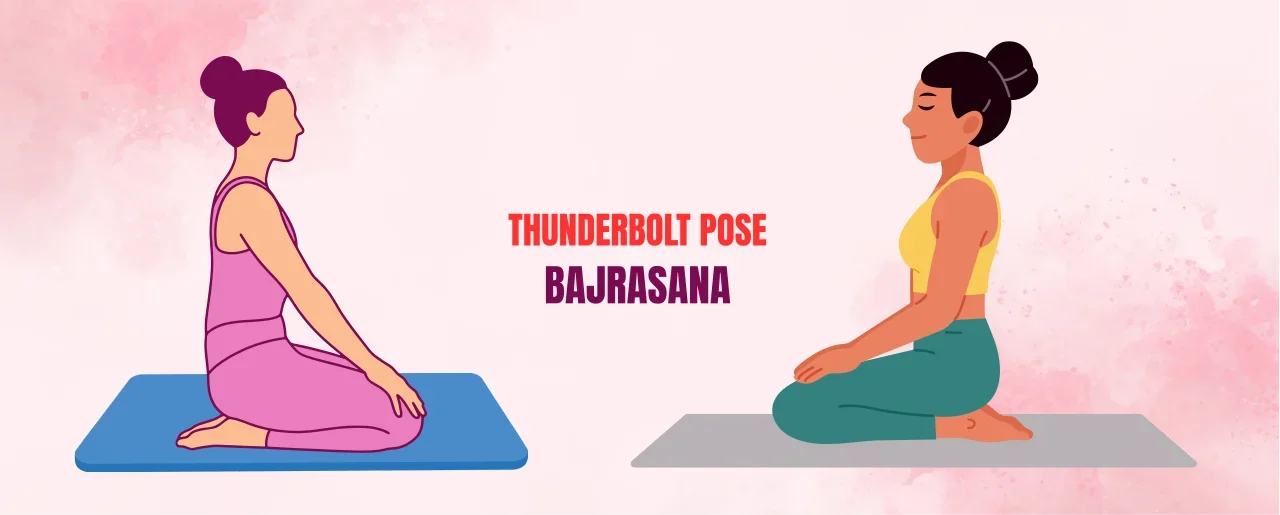
Bajrasana, also known as Thunderbolt Pose, is a simple seated yoga posture commonly practiced for meditation, mindful breathing, and relaxation. In this pose, the practitioner kneels and sits back toward the heels while keeping the spine comfortably upright.
Bajrasana can be included in a regular yoga routine because it provides a stable seated position without requiring complicated balancing movements. It is also commonly used as a comfortable posture for meditation and pranayama practices.
What Is Bajrasana?
Bajrasana is a kneeling seated yoga posture in which the legs are folded underneath the body and the hips rest toward the heels. The hands are usually placed comfortably on the thighs or knees while the spine remains naturally upright.
The name is associated with the Sanskrit word Vajra, traditionally referring to a thunderbolt or diamond-like quality. For this reason, the posture is commonly known as Thunderbolt Pose.
How to Do Bajrasana Step by Step
- Kneel comfortably on a yoga mat.
- Keep your knees together or slightly apart according to your comfort.
- Slowly lower your hips toward your heels.
- Sit back comfortably on your heels.
- Keep your toes pointing backward.
- Place your hands gently on your thighs or knees.
- Keep your spine naturally upright.
- Relax your shoulders and neck.
- Keep your head aligned with your spine.
- Breathe slowly and naturally while staying in the posture.
Benefits of Bajrasana
Bajrasana is a simple seated yoga posture that can support meditation, breathing awareness, and comfortable sitting during yoga practice.
1. Supports an Upright Sitting Position
Bajrasana encourages the practitioner to maintain a naturally upright torso. This can make it useful for meditation and breathing practices that require a stable seated position.
2. Encourages Mindful Breathing
Because the body remains relatively stable in Bajrasana, practitioners can focus more easily on slow and controlled breathing.
3. Useful for Meditation
Bajrasana can be used as a seated posture during meditation. Its simple structure allows the practitioner to focus on breathing, relaxation, and awareness rather than maintaining a complicated physical position.
4. Helps Develop Body Awareness
Practicing Bajrasana can encourage awareness of posture, breathing, muscle tension, and overall body alignment.
5. Suitable for Pranayama Practice
The upright seated position can also be used during certain pranayama and breathing exercises when it feels comfortable for the practitioner.
Bajrasana for Meditation and Pranayama
One of the practical uses of Bajrasana is as a stable seated position for meditation and pranayama. While practicing, keep the spine comfortably upright instead of making the back unnecessarily rigid.
Relax the shoulders, neck, jaw, and facial muscles. Keep your breathing natural and smooth. Beginners can start by sitting in the posture for a short period and gradually increase the duration according to comfort.
How Long Should You Sit in Bajrasana?
There is no single duration suitable for everyone. Beginners can begin with a short and comfortable period and slowly increase the duration as their body becomes accustomed to the position.
Comfortable alignment should always be more important than staying in the pose for a specific amount of time. If you experience significant discomfort in your knees, ankles, or feet, slowly come out of the posture and rest.
Precautions While Practicing Bajrasana
- Do not force your knees or ankles into an uncomfortable position.
- Stop practicing if you experience sharp or significant pain.
- Beginners should start with a short duration.
- Use a folded blanket or yoga support if extra cushioning is needed.
- Keep your breathing slow and natural.
- Avoid creating unnecessary tension in your shoulders, neck, or lower back.
- People with existing knee, ankle, or joint problems should seek suitable professional guidance before practicing.
If you have an existing injury, health condition, or mobility concern, consult an appropriately qualified healthcare professional or trained yoga instructor before adding Bajrasana to your yoga routine.
Bajrasana in Traditional Yoga Practice
Bajrasana is commonly included in traditional yoga routines because it provides a straightforward seated position for meditation, breathing exercises, relaxation, and concentration practices.
Students who want to understand yoga beyond individual postures can benefit from structured study that includes asana, pranayama, meditation, yoga philosophy, anatomy, and teaching methodology.
If you are interested in developing a deeper understanding of traditional yoga, explore our Best Yoga Teacher Training Nepal programs and learn yoga in a structured and supportive environment.
Conclusion
Bajrasana (Thunderbolt Pose) is a simple seated yoga posture that can be incorporated into meditation, pranayama, and regular yoga practice. The key is to maintain comfortable alignment, relaxed breathing, and avoid forcing the joints.
Practicing individual yoga poses alongside meditation, breathing techniques, philosophy, and proper guidance can help students develop a broader understanding of traditional yoga.