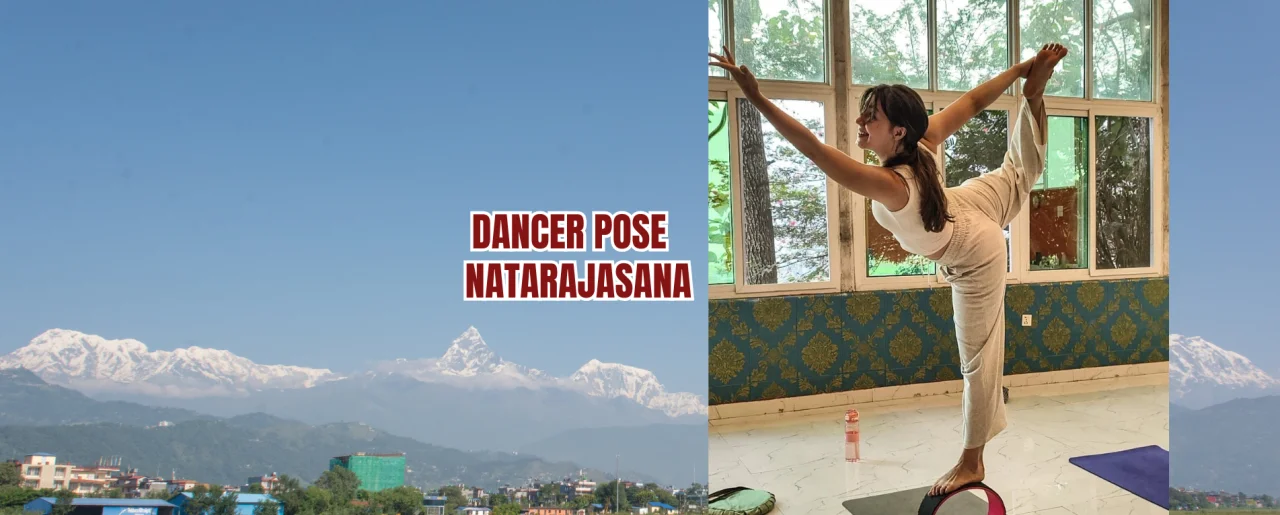
Dancer Pose, traditionally known as Natarajasana, is an elegant standing yoga posture that combines balance, strength, flexibility, concentration, and graceful movement. Named after Nataraja, the dancing form of Lord Shiva, this asana challenges the practitioner to remain steady while opening the chest, shoulders, hips, and front of the legs.
For beginners, Dancer Pose may initially feel challenging because it requires coordination between the standing leg, lifted leg, arms, spine, and core. With regular practice and proper alignment, it can become a powerful posture for developing physical stability and mental focus.
What Is Dancer Pose?
Dancer Pose, or Natarajasana, is a balancing yoga posture in which you stand on one leg while holding the opposite foot behind you. The lifted leg moves backward and upward while the torso gradually leans forward, creating a beautiful bow-like shape.
The posture requires several qualities at the same time:
- Balance and coordination
- Strong and stable legs
- Flexible hips and quadriceps
- Open shoulders and chest
- Core engagement
- Spinal mobility
- Concentration and body awareness
Because of its combination of strength and flexibility, Natarajasana is often included in intermediate yoga practices and yoga teacher training programs.
How to Perform Dancer Pose Step by Step
Step 1: Begin in Mountain Pose
Stand upright in Tadasana (Mountain Pose) with your feet comfortably grounded. Keep your spine long, shoulders relaxed, and gaze forward. Take a few slow breaths to establish your balance.
Step 2: Shift Your Weight
Gradually transfer your weight onto your left foot. Keep the standing leg strong without locking the knee. Bend your right knee and bring your right heel toward your right buttock.
Step 3: Hold the Foot
Reach your right hand backward and hold the inside or outside of your right foot or ankle, depending on your flexibility and the variation you are practicing. Keep your chest lifted.
Step 4: Begin the Backbend
Press your right foot into your hand and allow the right leg to move backward and upward. At the same time, extend your left arm forward. Rather than forcing the leg higher, focus on creating length through the spine.
Step 5: Find Your Balance
Gradually lean your torso forward as the lifted leg rises behind you. Keep your standing foot firmly connected to the floor and engage your core to stabilize your pelvis. Keep your gaze fixed on one steady point in front of you.
Step 6: Breathe and Hold
Take several slow, controlled breaths while maintaining the posture. Avoid holding your breath or forcing yourself deeper into the pose.
Step 7: Release Slowly
Lower the lifted leg with control, release your foot, and return to Tadasana. Repeat the posture on the opposite side.
Dancer Pose Alignment Tips
Proper alignment is more important than achieving a dramatic shape.
- Keep the standing foot grounded: Spread the toes and distribute your weight evenly across the foot.
- Engage the core: A stable core helps prevent excessive movement in the lower back.
- Keep the standing knee soft: Do not hyperextend or lock the knee.
- Lift through the chest: Lengthen the spine instead of collapsing into the lower back.
- Move the lifted leg gradually: The goal is controlled extension, not maximum height.
- Keep the hips relatively stable: Avoid allowing the pelvis to rotate excessively.
- Use your breath: Smooth breathing can help maintain concentration and reduce unnecessary muscular tension.
Benefits of Dancer Pose
1. Improves Balance
Dancer Pose challenges your ability to stabilize the body on one leg, helping develop balance, coordination, and body awareness.
2. Strengthens the Legs
The standing leg works continuously to support the body, while the lifted leg and surrounding muscles contribute to the posture.
3. Opens the Front of the Body
The pose provides a deep stretch across areas such as the quadriceps, hip flexors, shoulders, and chest.
4. Improves Hip Mobility
The lifted leg requires hip extension, making Natarajasana useful for developing greater awareness and mobility around the hips.
5. Develops Core Stability
Your abdominal and deep core muscles work to stabilize the pelvis and spine while you balance.
6. Encourages Better Concentration
Maintaining a one-legged balance requires a focused gaze and present-moment awareness, making Dancer Pose both a physical and mental practice.
7. Builds Confidence
As balance and coordination improve, practitioners can develop greater confidence when approaching challenging yoga postures.
Common Mistakes in Dancer Pose
Avoid these common errors when practicing Natarajasana:
- Trying to lift the back leg too high
- Collapsing into the lower back
- Locking the standing knee
- Allowing the standing foot to roll outward
- Opening the hips excessively
- Holding the breath
- Looking around instead of maintaining a steady gaze
- Prioritizing appearance over proper alignment
A beautiful Dancer Pose is not necessarily the deepest or highest version. Stability, breath, awareness, and controlled movement are more important than achieving a picture-perfect shape.
Dancer Pose for Beginners
If you are new to balancing postures, begin near a wall or another stable support. You can also use a yoga strap around the lifted foot if reaching the foot directly is difficult.
Practice first with a smaller range of movement. As your balance, hip mobility, and shoulder flexibility improve, gradually explore a deeper variation.
Do not force the posture. If you experience sharp pain, especially in the knee, hip, lower back, or shoulder, come out of the pose and seek guidance from a qualified yoga teacher.
Preparatory Poses for Natarajasana
Before practicing Dancer Pose, consider warming up with postures that prepare the legs, hips, shoulders, and spine:
- Tadasana
- Vrksasana (Tree Pose)
- Anjaneyasana (Low Lunge)
- Virabhadrasana I (Warrior I)
- Virabhadrasana III (Warrior III)
- Gomukhasana arms
- Bhujangasana (Cobra Pose)
- Dhanurasana (Bow Pose)
- Quadriceps and hip-flexor stretches
A gradual warm-up can make the posture safer and more comfortable.
Who Should Be Careful With Dancer Pose?
Practitioners with significant knee, hip, ankle, shoulder, or lower-back problems should approach Natarajasana cautiously and practice under appropriate professional guidance.
Pregnant practitioners and people recovering from injuries should consult an appropriately qualified healthcare professional or yoga professional before attempting challenging balancing and backbending variations.
Dancer Pose and Yoga Teacher Training
Learning an asana is different from learning how to teach an asana. A yoga teacher needs to understand alignment, modifications, contraindications, sequencing, verbal cues, breathing, and how to adapt the posture for different students.
If you want to develop a deeper understanding of yoga asanas and teaching methodology, exploring Nepal Yoga Teacher Training can be a valuable next step. Studying yoga in Nepal can provide an immersive environment where students can combine traditional yogic practices with structured teacher-training education.
For students looking for a comprehensive foundation, 200 Hour Yoga Teacher Training in Nepal can introduce important areas such as asana practice, pranayama, meditation, anatomy, yoga philosophy, teaching methodology, and practical teaching skills.
How Dancer Pose Fits Into a Yoga Practice
Natarajasana can be incorporated into a sequence after the body has been adequately warmed up. A teacher might prepare students with standing balances, hip-opening movements, quadriceps stretches, and gentle backbends before introducing the pose.
A simple progression could be:
Tadasana → Vrksasana → Warrior III → Low Lunge → Quadriceps Stretch → Dancer Pose → Standing Forward Fold → Tadasana
The sequence should always be adapted according to the student's experience, mobility, and physical needs.
Final Thoughts
Dancer Pose is more than an impressive balancing posture. It teaches the practitioner how to combine strength with flexibility, movement with stability, and effort with concentration.
With consistent practice, patience, and correct alignment, Natarajasana can become a rewarding part of a well-rounded yoga practice. If your goal extends beyond personal practice and you want to understand how to safely teach yoga to others, structured teacher training can help you develop the knowledge and practical skills required to guide students confidently.
Practice with patience, breathe steadily, and remember that balance is not about being perfectly still—it is about learning how to respond to movement with awareness.