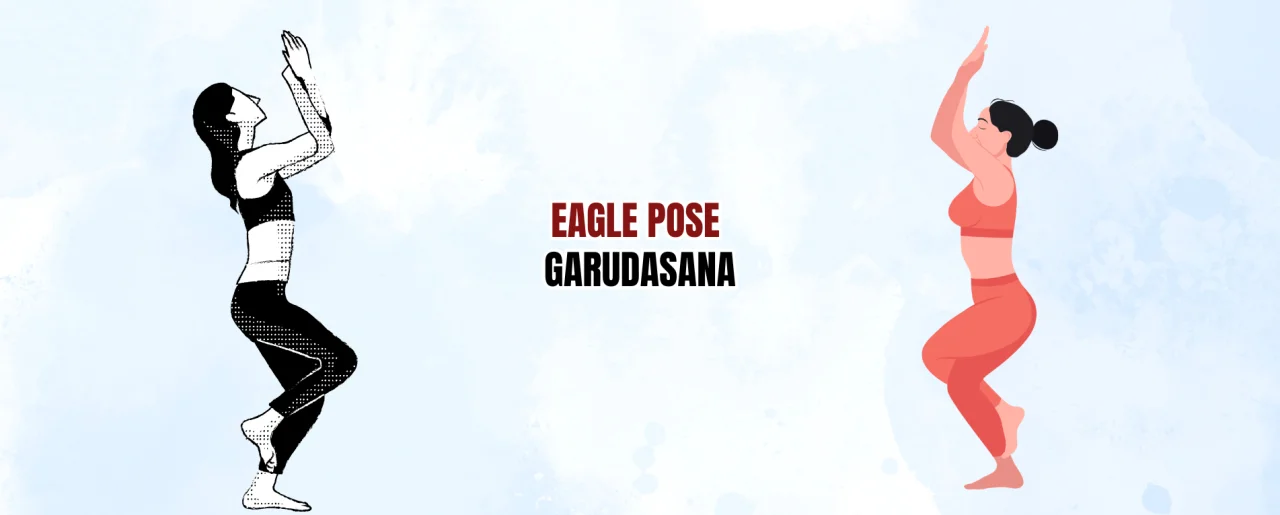
Eagle Pose, traditionally known as Garudasana, is a standing yoga posture that develops balance, concentration, flexibility, and body awareness. The pose involves wrapping one leg around the other while crossing the arms, creating a compact posture that challenges both physical stability and mental focus.
Practicing Garudasana regularly can help improve coordination, strengthen the legs, and release tension around the shoulders and upper back. It is also a useful posture for yoga practitioners who want to develop greater control and awareness of their body.
How to Practice Eagle Pose (Garudasana)
Follow these steps to practice Eagle Pose safely:
- Stand upright in Tadasana with your feet together and your spine neutral.
- Bend your knees slightly and shift your weight onto your left foot.
- Lift your right foot and cross your right thigh over your left thigh.
- If comfortable, wrap your right foot around the back of your left calf.
- Extend your arms forward and cross your left arm over your right arm.
- Bend your elbows and bring your palms toward each other.
- Keep your chest lifted while gently bending the standing leg.
- Focus your gaze on one fixed point to maintain balance.
- Hold the posture for several comfortable breaths.
- Slowly release and repeat on the opposite side.
Benefits of Eagle Pose
Garudasana offers several potential physical and mental benefits when practiced with proper alignment and within your comfortable range of motion.
1. Improves Balance
The single-leg position challenges your stability and encourages greater body awareness. Maintaining a steady gaze can also improve concentration during the posture.
2. Strengthens the Legs
The standing leg works to support the body while the knees remain bent, helping develop strength and stability in the legs and lower body.
3. Improves Flexibility
The crossed-leg position provides a gentle challenge to the hips, thighs, and ankles. The arm position can also encourage mobility around the shoulders and upper back.
4. Releases Shoulder and Upper-Back Tension
The crossed arms create a gentle stretch across the upper back and shoulders, which may help release muscular tightness when performed comfortably.
5. Develops Concentration
Garudasana requires physical balance and mental attention at the same time. Regular practice can help develop focus and mindful awareness.
6. Enhances Coordination
Coordinating the arms, legs, breathing, and gaze makes Eagle Pose a useful posture for developing overall body coordination.
Eagle Pose Alignment Tips
Proper alignment is important when practicing Garudasana. Keep your spine relatively upright and avoid collapsing the chest. Engage your standing leg and maintain steady, controlled breathing.
If wrapping the foot around the calf is uncomfortable or affects your balance, simply cross the thighs without forcing the foot to hook around the lower leg. Similarly, the hands do not have to touch if your shoulders are tight.
The goal is not to achieve the deepest possible position. Instead, focus on stability, comfortable movement, controlled breathing, and proper body awareness.
Common Mistakes to Avoid
- Rounding or collapsing the spine excessively.
- Forcing the legs into a tight wrap.
- Holding the breath.
- Looking around instead of maintaining a steady gaze.
- Putting excessive pressure on the standing knee.
- Trying to achieve the full pose before developing sufficient balance.
Precautions and Modifications
People with existing knee, ankle, hip, or shoulder injuries should practice Garudasana carefully and consider guidance from a qualified yoga professional. Avoid forcing the joints into uncomfortable positions.
Beginners can practice a modified version by keeping the toes of the crossed leg lightly on the floor instead of wrapping the foot around the calf. A wall can also be used for additional balance support.
Learn Garudasana and Traditional Yoga Practices in Nepal
If you want to develop a deeper understanding of yoga beyond individual asanas, studying under experienced teachers can provide valuable guidance on alignment, breathing, meditation, philosophy, and traditional yoga practices.
A yoga teacher training school in Nepal can provide an immersive environment to explore yoga practice while experiencing the natural and spiritual surroundings of Nepal.
For practitioners looking for more comprehensive training, a 500 hour yoga teacher training in Nepal can offer an opportunity to study yoga in greater depth, including asana practice, pranayama, meditation, anatomy, teaching methodology, and yoga philosophy.
Conclusion
Eagle Pose, or Garudasana, is a challenging yet rewarding yoga posture that combines balance, strength, flexibility, coordination, and concentration. Practicing it patiently and with proper alignment can make it a valuable addition to a well-rounded yoga routine.
Rather than focusing only on how deeply you can perform the pose, concentrate on steady breathing, controlled movement, and mindful awareness. With consistent practice, Garudasana can become an effective posture for developing both physical stability and mental focus.