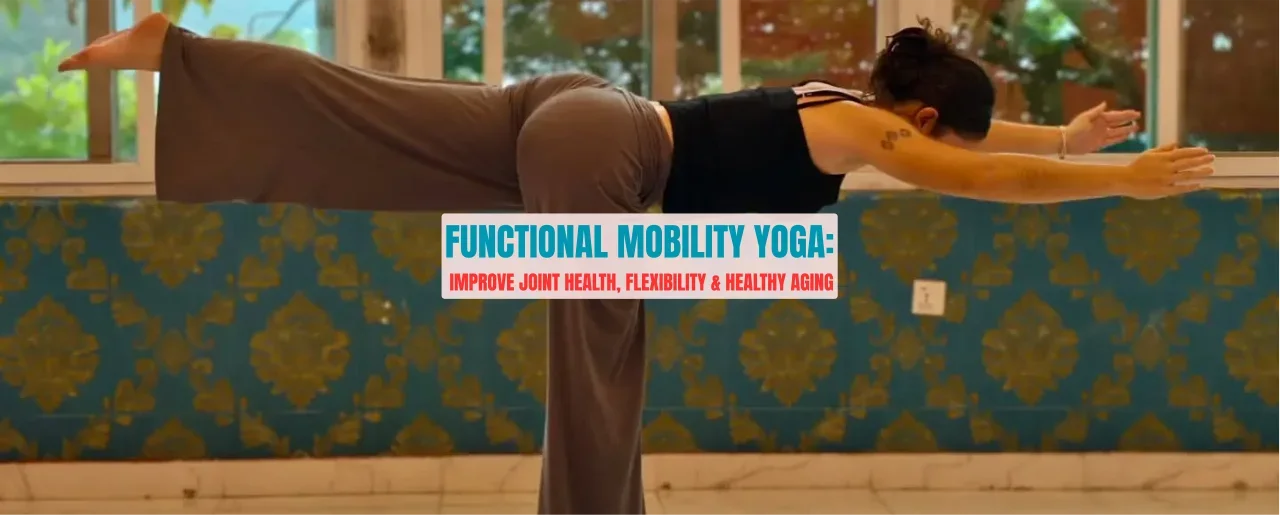
Explore how functional mobility yoga combines controlled movement, balance, flexibility and body awareness to support everyday activities and long-term physical well-being.
What Is Functional Mobility Yoga?
Functional mobility yoga combines traditional yoga movements with exercises designed to improve how the body moves during everyday activities. It focuses on developing comfortable joint movement, muscular control, balance, coordination and flexibility.
Unlike flexibility training that focuses primarily on stretching muscles, functional mobility also considers how different joints and muscle groups work together. The goal is to make everyday movements such as walking, bending, reaching, turning and getting up from a chair more comfortable and controlled.
This approach can be useful for beginners, experienced yoga practitioners, people with sedentary lifestyles and adults who want to maintain physical independence as they age.
1. Why Is Joint Mobility Important?
Joints allow different parts of the body to move in multiple directions. Maintaining comfortable movement through an appropriate range of motion is important for everyday physical activities.
Limited mobility can make simple tasks feel more difficult, particularly when combined with inactivity, muscular weakness or prolonged sitting.
Benefits of Regular Mobility Practice
- Comfortable movement: Controlled exercises can help maintain functional joint range of motion.
- Better body awareness: Practitioners become more familiar with how their body moves.
- Muscular control: Mobility exercises can develop strength and control around moving joints.
- Movement coordination: Repeated controlled movements help practise coordination between different body parts.
- Everyday independence: Maintaining strength, balance and mobility can support daily activities as people age.
2. Functional Mobility Yoga Exercises to Try
A functional mobility routine does not need to be complicated. Simple movements performed with proper control can provide a useful starting point.
Cat-Cow Pose (Marjaryasana-Bitilasana)
Cat-Cow is a gentle movement that involves alternating between spinal flexion and extension. It encourages spinal awareness and helps practitioners explore comfortable movement through the back.
How to practise:
- Begin on your hands and knees.
- Place your wrists under your shoulders and knees under your hips.
- Inhale and gently lift your chest while allowing your back to arch comfortably.
- Exhale and round your spine gently.
- Repeat slowly while coordinating movement with your breath.
Low Lunge (Anjaneyasana)
Low Lunge encourages movement around the hips and can help improve hip flexibility when performed with appropriate alignment.
How to practise:
- Step one foot forward into a lunge position.
- Lower the opposite knee onto a comfortable surface.
- Keep your front knee aligned comfortably over your ankle.
- Gently move your hips forward without forcing the stretch.
- Hold briefly and repeat on the other side.
Malasana (Yogic Squat)
Malasana encourages hip, ankle and lower-body mobility. Beginners can use a yoga block or support under the heels to make the position more comfortable.
Shoulder Mobility Circles
Gentle shoulder circles help practise controlled movement around the shoulder joints. Keep the movement within a comfortable range and avoid forcing the arms overhead.
Warrior II (Virabhadrasana II)
Warrior II combines lower-body strength, balance and controlled positioning. It also encourages awareness of hip and knee alignment during standing movement.
3. Functional Mobility Yoga for Healthy Aging
Maintaining mobility becomes increasingly important as people grow older. Age-related changes in muscle strength, balance and joint movement can affect everyday activities.
A regular, appropriately adapted yoga and mobility routine can help older adults maintain physical activity, balance, muscular strength and flexibility.
How Mobility Exercises Support Active Aging
- Balance practice: Standing yoga postures help develop balance and coordination.
- Strength maintenance: Weight-bearing movements can help maintain functional muscular strength.
- Flexibility: Gentle stretching supports comfortable movement.
- Postural awareness: Controlled movements encourage awareness of spinal and body alignment.
- Daily movement: Practising functional movements can help prepare the body for common everyday activities.
Yoga is not a substitute for medical treatment or rehabilitation. Older adults with balance difficulties, joint pain or existing health conditions should choose suitable exercises with guidance from a qualified professional.
4. Functional Mobility Yoga vs Traditional Stretching
Both mobility training and stretching are useful components of physical fitness, but they have different emphases.
| Feature | Traditional Stretching | Functional Mobility Yoga |
|---|---|---|
| Main focus | Muscle flexibility | Controlled joint movement and flexibility |
| Movement style | Static or dynamic stretching | Controlled, coordinated movement |
| Strength component | Usually limited | Can include strength and stability |
| Balance | Not always included | Often incorporated |
| Everyday application | Supports flexibility | Practises movement patterns used in daily activities |
5. How to Build a Simple Functional Mobility Routine
Beginners can start with a short routine that includes gentle movements for the spine, shoulders, hips and ankles.
- Warm-up: Begin with gentle walking or comfortable joint movements.
- Spinal mobility: Practise Cat-Cow slowly and comfortably.
- Hip mobility: Include supported Low Lunge movements.
- Shoulder movement: Perform controlled shoulder circles.
- Balance: Practise a supported standing posture such as Warrior II.
- Cool-down: Finish with gentle stretching and relaxed breathing.
Start with a few repetitions of each exercise rather than aiming for a particular duration or intensity. Increase the difficulty gradually as your comfort and control improve.
6. The Role of Yoga Education in Understanding Human Movement
Learning about mobility, alignment, breathing and body mechanics can deepen a practitioner's understanding of yoga. These concepts are particularly relevant for people who want to develop a more informed and responsible approach to teaching yoga.
Students interested in traditional yoga philosophy, asana practice, pranayama and meditation can explore Nepal yoga teacher training at Pokhara Yoga School and Retreat Center.
For practitioners who have already completed a 200-hour yoga teacher training course and want to advance their knowledge, the 300 hour yoga teacher training in Nepal offers a dedicated advanced study pathway.
7. Common Mistakes to Avoid During Mobility Practice
- Forcing stretches: Never push a joint beyond its comfortable range of motion.
- Ignoring alignment: Pay attention to the position of your knees, hips, shoulders and spine.
- Moving too quickly: Controlled movement is more important than speed.
- Skipping warm-ups: Begin with gentle movements before attempting more demanding postures.
- Ignoring pain: Stop an exercise if it causes sharp pain, numbness or unusual discomfort.
- Comparing flexibility: Every body has different movement capabilities and limitations.
Conclusion
Functional mobility yoga offers a practical way to combine flexibility, balance, strength and controlled movement. By focusing on how the body moves rather than simply how far it can stretch, practitioners can develop a more balanced approach to physical activity.
Whether you are new to yoga or have years of experience, consistent and mindful movement can be a valuable part of maintaining an active lifestyle and supporting healthy aging.