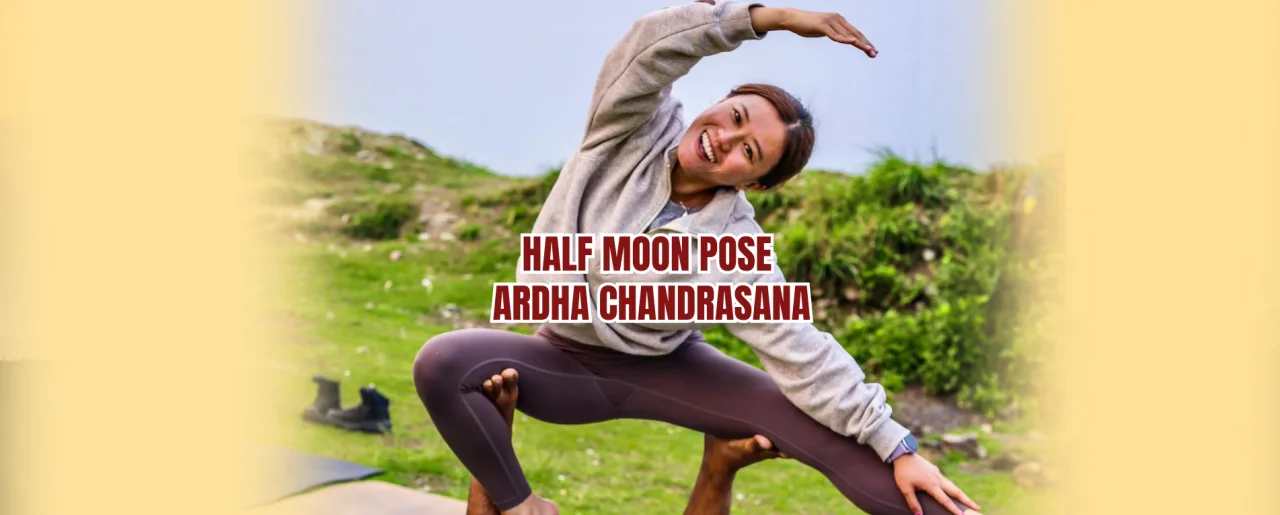
Half Moon Pose, also known as Ardha Chandrasana, is a balancing yoga posture that combines strength, flexibility, stability, and concentration. The pose involves balancing on one leg while extending the opposite leg backward and reaching one arm toward the sky.
With regular and mindful practice, Ardha Chandrasana can help develop lower-body strength, improve balance, and increase awareness of body alignment.
How to Practice Half Moon Pose
- Begin in a standing position with your feet comfortably apart.
- Step your left foot forward and bend the left knee slightly.
- Place your left hand on the floor or on a yoga block outside the left foot.
- Shift your weight onto the left leg.
- Slowly lift your right leg backward until it becomes roughly parallel to the floor.
- Open your hips gently toward the right side.
- Extend your right arm toward the ceiling while keeping your chest open.
- Keep your gaze forward or, if comfortable, turn your gaze toward the raised hand.
- Engage your standing leg and maintain steady, relaxed breathing.
- Hold for several breaths before slowly returning to the starting position and repeating on the opposite side.
Benefits of Half Moon Pose
1. Improves Balance and Stability
Ardha Chandrasana challenges your ability to balance on one leg, helping develop stability and body awareness.
2. Strengthens the Lower Body
The standing leg, glutes, thighs, and muscles around the hips work actively to support the posture.
3. Opens the Hips
The lifted-leg position encourages hip mobility while the open variation of the posture creates a gentle stretch around the hips and pelvis.
4. Improves Core Strength
Maintaining a stable torso while balancing requires engagement of the abdominal and supporting muscles.
5. Enhances Coordination
The posture combines balance, leg strength, upper-body positioning, and controlled breathing, making it useful for developing coordination.
6. Develops Concentration
Because Half Moon Pose requires continuous attention to balance and alignment, it can encourage focus and mindful awareness.
Half Moon Pose Alignment Tips
Keep the standing leg strong without locking the knee. Press firmly through the standing foot and extend through the lifted leg.
Try to keep the chest open rather than collapsing toward the floor. Your supporting hand can rest on a yoga block if reaching the floor causes you to round your back or lose balance.
The lifted leg does not need to be perfectly horizontal. Focus on maintaining a stable spine and comfortable hip alignment rather than forcing the leg higher.
Common Mistakes to Avoid
- Locking the standing knee.
- Forcing the lifted leg too high.
- Collapsing the chest toward the floor.
- Putting excessive weight on the supporting hand.
- Holding the breath.
- Turning the head too quickly when balance is not established.
- Forcing the hips open beyond a comfortable range.
Modifications for Beginners
Beginners can practice Half Moon Pose with a yoga block underneath the supporting hand. Practicing near a wall can also provide additional stability.
If balancing on one leg is difficult, focus first on developing strength and balance through simpler standing poses before attempting the full posture.
Precautions
Practice Ardha Chandrasana carefully if you have an existing injury involving the ankle, knee, hip, wrist, or lower back. Avoid forcing the posture or remaining in it if you experience sharp pain, dizziness, or significant discomfort.
If you are new to yoga or have a physical limitation, learning the pose under the guidance of a qualified yoga teacher can help you understand appropriate modifications and alignment.
Learn Yoga in Nepal
If you want to deepen your understanding of yoga beyond individual asanas, studying with experienced teachers can help you explore yoga philosophy, meditation, pranayama, anatomy, alignment, and teaching methodology.
A yoga teacher training school in Nepal can provide an immersive learning environment where students can develop their yoga practice while experiencing the natural beauty and spiritual atmosphere of Nepal.
For students seeking an advanced and comprehensive learning experience, a 500 hour yoga teacher training in Nepal can provide deeper study of traditional yoga practices, asana, pranayama, meditation, anatomy, philosophy, and teaching skills.
Conclusion
Half Moon Pose, or Ardha Chandrasana, is a dynamic balancing posture that combines strength, flexibility, coordination, and concentration. Practicing the pose with patience and proper alignment can help develop greater stability and body awareness.
Use props such as a yoga block whenever necessary, and focus on controlled breathing and comfortable movement rather than forcing the body into the final position.