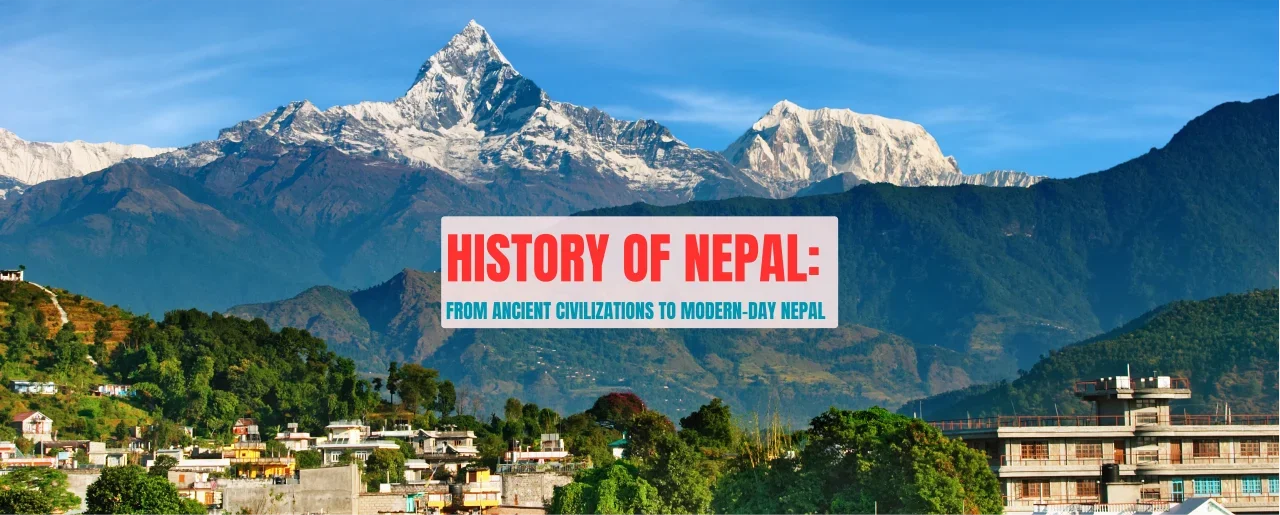
Nepal is a country where ancient traditions, spiritual wisdom, magnificent architecture, and breathtaking Himalayan landscapes come together. Located between India and China, this beautiful Himalayan nation has a fascinating history shaped by ancient kingdoms, religious traditions, powerful dynasties, cultural exchanges, and political transformations. From the birthplace of Gautama Buddha to the historic temples of Kathmandu and the majestic mountains of the Himalayas, Nepal has played an important role in the cultural and spiritual history of South Asia.
The history of Nepal stretches back thousands of years. It includes the development of ancient settlements, the rise of the Licchavi and Malla dynasties, the unification of Nepal under King Prithvi Narayan Shah, the Rana period, the establishment of democracy, and the formation of the Federal Democratic Republic of Nepal in 2008.
Beyond its political history, Nepal is internationally recognized for its contributions to Hinduism and Buddhism, traditional arts, architecture, meditation, and yoga. Its spiritual atmosphere and connection with the Himalayas continue to attract travelers, historians, spiritual seekers, and yoga practitioners from around the world.
Let's explore the remarkable journey of Nepal through its most important historical periods and understand how its ancient heritage continues to influence modern Nepali culture.
1. Ancient History of Nepal: The Beginning of Civilization
The ancient history of Nepal is associated with early settlements, traditional kingdoms, and the development of distinctive cultural and religious practices. The Kathmandu Valley became an important center of civilization because of its fertile land, strategic geographical position, and connections with neighboring regions.
According to traditional historical accounts, the early rulers of the Kathmandu Valley included the Gopala, Mahishapala, and Kirata dynasties. Although details of some early periods remain debated, archaeological discoveries, inscriptions, and historical traditions provide valuable insights into Nepal's ancient past.
The Kirata Period
The Kirata period is traditionally associated with early rulers of the Kathmandu Valley. Kirata communities contributed to the region's cultural development, agricultural practices, and social traditions. Their historical legacy remains an important part of Nepal's cultural identity.
Birthplace of Gautama Buddha
One of the most significant events in Nepal's ancient history is the birth of Siddhartha Gautama, who later became known as Gautama Buddha. He was born in Lumbini, located in present-day Rupandehi District of Nepal.
Born into the Shakya community, Siddhartha Gautama eventually left his royal surroundings in search of answers to human suffering. Through meditation and spiritual discipline, he attained enlightenment and established the teachings that became the foundation of Buddhism.
Today, Lumbini is a UNESCO World Heritage Site and an important pilgrimage destination for Buddhists from across the world. The Maya Devi Temple, Ashoka Pillar, monasteries, and archaeological remains make Lumbini one of the most significant spiritual destinations in Nepal.
2. The Licchavi Dynasty: A Golden Period of Art and Culture
The Licchavi period, generally associated with approximately the fourth to ninth centuries CE, is considered one of the most important phases in Nepal's early recorded history. This era witnessed considerable developments in administration, trade, architecture, sculpture, religion, and literature.
Historical inscriptions provide important evidence about the Licchavi rulers and their contributions. King Manadeva I is particularly associated with the famous Changu Narayan inscription dating to 464 CE, one of the earliest important dated inscriptions discovered in the Kathmandu Valley.
During this period, Hinduism and Buddhism developed alongside one another. Temples, religious monuments, stone sculptures, and traditional artistic practices became important features of society.
The Licchavi period also strengthened cultural connections between Nepal, Tibet, and the Indian subcontinent. These exchanges influenced religious practices, artistic traditions, and architectural styles that remain visible throughout Nepal today.
3. The Malla Dynasty: Nepal's Cultural and Architectural Heritage
The Malla period, beginning around the twelfth century, played a major role in shaping Nepal's artistic and architectural identity. The Malla rulers encouraged the development of temples, palaces, public squares, literature, music, festivals, and traditional craftsmanship.
During the later Malla period, the Kathmandu Valley developed into three important independent kingdoms:
- Kantipur (Kathmandu): Known for its historic temples, traditional architecture, and vibrant cultural heritage.
- Lalitpur (Patan): Famous for traditional metalwork, Buddhist monuments, artistic craftsmanship, and Patan Durbar Square.
- Bhaktapur: Recognized for its traditional Newari culture, pottery, wood carving, and Bhaktapur Durbar Square.
These kingdoms competed in architecture, art, and cultural development, resulting in some of Nepal's most remarkable historical monuments.
Several monuments from this period are now included in the Kathmandu Valley UNESCO World Heritage property. Their intricate wooden windows, pagoda-style temples, stone sculptures, and beautifully designed courtyards reflect the artistic excellence of medieval Nepal.
The Malla period also strengthened the relationship between Hindu and Buddhist traditions. Many communities practiced both religious traditions, creating a distinctive spiritual environment that continues to characterize the Kathmandu Valley.
4. Unification of Nepal Under King Prithvi Narayan Shah
Before the unification of Nepal, the region consisted of numerous independent kingdoms and principalities. The Gorkha Kingdom gradually became a powerful political force under the leadership of King Prithvi Narayan Shah.
Prithvi Narayan Shah became the King of Gorkha in 1743 and began an ambitious campaign to unite the neighboring territories. His military campaigns eventually brought the important kingdoms of the Kathmandu Valley under Gorkha control.
In 1768, Gorkhali forces captured Kathmandu, followed by further victories in the valley. The capture of Bhaktapur in 1769 completed the unification of the three major Malla kingdoms.
This historical transformation laid the foundation for modern Nepal as a unified kingdom. Prithvi Narayan Shah is therefore widely remembered as the founder of unified Nepal.
His political ideas, commonly associated with Divya Upadesh, remain an important part of discussions about Nepal's national identity, independence, and foreign relations.
5. The Rana Regime: A Century of Political Control
In 1846, Jung Bahadur Rana established a political system that placed effective executive power in the hands of the Rana family. The Rana prime ministers exercised hereditary control over the government, while the Shah kings largely became ceremonial figures.
The Rana regime continued for approximately 104 years, from 1846 until 1951. During this period, Nepal experienced significant political centralization and remained relatively isolated from much of the outside world.
Although certain infrastructure, administrative, and educational developments took place, political freedom and public participation in government remained severely restricted.
Growing public dissatisfaction eventually led to a democratic movement supported by political groups and King Tribhuvan. In 1951, the Rana regime came to an end, opening a new chapter in Nepal's political history.
6. The Democratic Movement and Political Transformation
After the end of Rana rule, Nepal began moving toward a more democratic political system. However, the journey was not straightforward, as political power continued to shift between the monarchy, elected representatives, and political movements.
The First Democratic Elections
In 1959, Nepal held its first parliamentary elections. The Nepali Congress won the election, and Bishweshwar Prasad Koirala became the country's first democratically elected prime minister.
However, in 1960, King Mahendra dissolved Parliament and introduced a partyless Panchayat political system. This system continued until the democratic movement of 1990.
The People's Movement of 1990
The People's Movement of 1990 brought significant political changes. Following widespread public demonstrations, King Birendra accepted constitutional reforms and restored multiparty democracy.
This development established a constitutional monarchy with an elected parliament and marked an important step toward greater political participation.
The People's Movement of 2006
Nepal experienced another major political transformation in 2006. A nationwide democratic movement challenged the absolute powers assumed by King Gyanendra.
The movement resulted in the restoration of Parliament and accelerated the peace process between the government and Maoist representatives. The Comprehensive Peace Agreement was signed on November 21, 2006, establishing an important foundation for Nepal's political transition.
7. Nepal Becomes a Federal Democratic Republic in 2008
One of the most significant milestones in modern Nepalese history occurred on May 28, 2008. The newly elected Constituent Assembly officially abolished the monarchy and declared Nepal a Federal Democratic Republic.
This decision ended approximately 240 years of Shah dynasty rule and transformed Nepal's political structure.
The country subsequently worked toward establishing a new constitutional framework. On September 20, 2015, Nepal promulgated its new Constitution, establishing the foundation of its present federal democratic system.
Modern Nepal is organized into seven provinces, with a federal government, provincial governments, and local administrative structures. Kathmandu remains the country's capital and its principal political and administrative center.
8. Nepal's Religious and Spiritual Heritage
Nepal's history is not only about kings, kingdoms, and political developments. Its spiritual and religious traditions have played an equally important role in shaping its identity.
Hinduism and Buddhism have influenced Nepalese society for centuries. Numerous temples, monasteries, stupas, sacred mountains, and pilgrimage sites reflect this rich spiritual heritage.
Hinduism in Nepal
Hindu traditions have influenced Nepalese festivals, architecture, cultural practices, and everyday life. Some of the country's most important Hindu pilgrimage destinations include:
- Pashupatinath Temple: One of the most important temples dedicated to Lord Shiva, situated beside the Bagmati River in Kathmandu.
- Muktinath Temple: A sacred pilgrimage destination in the Mustang region, revered by both Hindu and Buddhist communities.
- Janaki Temple: A significant temple in Janakpur associated with Goddess Sita.
- Manakamana Temple: A popular pilgrimage destination dedicated to Goddess Bhagwati.
Buddhism in Nepal
Nepal has a special place in Buddhist history because Lumbini is recognized as the birthplace of Gautama Buddha. Buddhist traditions have also flourished in the Kathmandu Valley and Himalayan regions for centuries.
Important Buddhist destinations include:
- Boudhanath Stupa: One of the largest and most important Buddhist stupas in Nepal.
- Swayambhunath: An ancient religious complex popularly known as the Monkey Temple.
- Lumbini: The sacred birthplace of Gautama Buddha.
- Namobuddha: An important Buddhist pilgrimage destination near Kathmandu.
These sacred places demonstrate how Nepal has preserved its spiritual traditions while welcoming people from different cultures and religious backgrounds.
9. The History and Development of Yoga in Nepal
Yoga has a deep connection with the broader spiritual and philosophical traditions of the Indian subcontinent, including Nepal. For centuries, yogic practices, meditation, pranayama, ascetic traditions, and spiritual disciplines have been part of Himalayan religious and cultural life.
Nepal's peaceful mountain environment, ancient temples, Buddhist monasteries, and Hindu pilgrimage sites have made the country an attractive destination for individuals seeking spiritual knowledge and personal development.
Traditional yoga is much more than physical exercise. It is a holistic discipline that brings together the body, breath, and mind through practices such as:
- Hatha Yoga: Traditional physical practices involving asanas, breathing, and bodily awareness.
- Ashtanga Yoga: A structured and disciplined approach to yoga practice and movement.
- Pranayama: Breathing practices that develop awareness and control of the breath.
- Meditation: Techniques that encourage concentration, mindfulness, and self-awareness.
- Yoga Philosophy: The study of traditional yogic teachings, ethical principles, and the purpose of yoga.
Today, Nepal continues to attract international yoga students who wish to explore traditional yoga practices in a peaceful Himalayan setting.
For aspiring yoga instructors, enrolling in a structured training program can provide an opportunity to study yoga philosophy, anatomy, asanas, pranayama, meditation, and teaching methodology.
10. Why Nepal Is an Ideal Destination for Yoga Teacher Training
Nepal offers a unique environment for learning and practicing yoga. Its natural beauty, spiritual heritage, welcoming communities, and Himalayan surroundings create an inspiring atmosphere for yoga education.
Pokhara is particularly popular among yoga practitioners because of its beautiful mountain scenery, peaceful surroundings, and access to natural attractions such as Phewa Lake and the Annapurna region.
Students choosing Nepal for yoga teacher training can benefit from:
- A peaceful Himalayan environment for focused learning and personal development.
- Opportunities to study traditional Hatha Yoga and Ashtanga Yoga.
- Exposure to yoga philosophy, meditation, and pranayama.
- Interaction with international students and experienced yoga instructors.
- Opportunities to explore Nepalese culture, temples, monasteries, and natural attractions.
- A balanced learning experience combining yoga education, self-practice, and cultural exploration.
Explore 200-Hour Yoga Teacher Training in Nepal
If you are beginning your journey toward becoming a professional yoga instructor, a 200-hour course can help you develop a strong foundation in yoga practice and teaching.
At Pokhara Yoga School and Retreat Center, students can explore traditional Hatha Yoga, Ashtanga Yoga, pranayama, meditation, yoga philosophy, anatomy, and teaching techniques through a structured training program.
The 200 Hour Yoga Teacher Training in Nepal is designed for learners who want to deepen their understanding of yoga and develop the knowledge and practical skills needed to begin teaching.
Whether you are a beginner or an existing yoga practitioner, this training provides an opportunity to explore yoga in the beautiful Himalayan surroundings of Pokhara.
Advance Your Practice with 500-Hour Yoga Teacher Training in Nepal
For practitioners who want to explore yoga at a deeper level, advanced teacher training offers an opportunity to develop more comprehensive knowledge and teaching skills.
The 500 Hour Yoga Teacher Training in Nepal at Pokhara Yoga School and Retreat Center combines foundational and advanced yoga education. The program explores Hatha Yoga, Ashtanga Yoga, advanced asana practice, pranayama, meditation, yoga philosophy, anatomy, alignment, and teaching methodology.
This comprehensive training is suitable for learners seeking a deeper understanding of traditional yoga and a more advanced professional teaching pathway. It provides an opportunity to develop personal practice while strengthening the skills needed to guide other yoga practitioners.
11. Modern Nepal: Tourism, Culture, and Global Recognition
Modern Nepal is known around the world for its natural beauty, rich cultural heritage, mountaineering opportunities, adventure tourism, and spiritual traditions.
Mount Everest, the Annapurna mountain range, Lumbini, Kathmandu Valley, Chitwan National Park, and Pokhara attract visitors from different parts of the world.
Tourism has become an important part of Nepal's economy, providing opportunities in hospitality, trekking, mountaineering, cultural tourism, wellness, and yoga education.
Some of Nepal's most popular attractions include:
- Mount Everest: The world's highest mountain above sea level and a major destination for mountaineers.
- Pokhara: A beautiful lakeside city known for Himalayan views, adventure activities, and yoga retreats.
- Kathmandu Valley: A cultural center containing historic temples, palaces, stupas, and traditional settlements.
- Chitwan National Park: A UNESCO World Heritage Site known for its wildlife and biodiversity.
- Lumbini: The birthplace of Gautama Buddha and an important international pilgrimage destination.
As Nepal continues to develop, it remains committed to preserving its historical monuments, cultural traditions, religious heritage, and natural environment.
12. Important Historical Timeline of Nepal
The following timeline highlights some of the most important milestones in Nepal's long and fascinating history.
| Period / Year | Historical Event |
|---|---|
| Ancient Period | Early settlements and traditional Gopala, Mahishapala, and Kirata dynasties. |
| 6th–5th Century BCE | Traditional dating of the birth of Siddhartha Gautama in Lumbini; the precise date remains debated. |
| 4th–9th Century CE | Licchavi period and significant developments in art, architecture, inscriptions, and administration. |
| 12th Century Onward | Rise of the Malla dynasty and expansion of traditional art and architecture. |
| 1482–1484 | Division of the Kathmandu Valley's Malla kingdom into separate kingdoms. |
| 1743 | Prithvi Narayan Shah becomes King of Gorkha. |
| 1768–1769 | Gorkhali forces capture the major kingdoms of the Kathmandu Valley. |
| 1846 | Jung Bahadur Rana establishes the Rana political regime. |
| 1951 | End of Rana rule and restoration of the monarchy's political authority. |
| 1959 | Nepal holds its first parliamentary elections. |
| 1990 | People's Movement restores multiparty democracy. |
| 2006 | People's Movement and Comprehensive Peace Agreement. |
| May 28, 2008 | Nepal officially becomes a Federal Democratic Republic. |
| September 20, 2015 | New Constitution of Nepal is promulgated. |
Conclusion: Discover the Timeless Heritage of Nepal
The history of Nepal is a remarkable story of ancient civilizations, spiritual traditions, artistic achievements, political transformation, and cultural resilience. From the birthplace of Gautama Buddha in Lumbini to the historic temples of Kathmandu and the unification of the country under Prithvi Narayan Shah, every historical period has contributed to the Nepal we know today.
Even in the modern era, Nepal continues to preserve its ancient traditions while welcoming people from across the world. Its Himalayan environment, cultural diversity, and spiritual heritage make it an extraordinary destination for history enthusiasts, travelers, and yoga practitioners.
For those interested in exploring the deeper meaning of yoga, Nepal offers an opportunity to connect with traditional teachings while experiencing the peaceful surroundings of the Himalayas. Whether you are considering a 200-hour Yoga Teacher Training in Nepal or looking to advance your knowledge through a 500-hour Yoga Teacher Training in Nepal, Pokhara can be a meaningful destination for your journey.
Explore Nepal, discover its extraordinary past, and experience the timeless wisdom of yoga in the heart of the Himalayas.